
A Pagan Confession
What does Fortissax believe?

I. Introduction
The primary purpose of Fortissax is Typing, and indeed, most of my work as a Canadian nationalist is to facilitate indigeneity and the collective consciousness of rooted nationhood among the Canadian people. Through education and storytelling, I focus my talents on myth-making and Canadian history. My aim is to give Canadians what they have been robbed of by a top-down, state enforced, managerial left-liberal regime that was already well established before I was born, so that they may undo the unforgiveable crimes they’ve been subjected to, and go forward into a difficult future with the knowledge, confidence and purpose to build a brighter future for us all.
Occasionally, I delve into the broader cultural commentary of the dissident right, now by many as the “ascendant right,” as our cultural, ideological, and philosophical influence is increasingly felt in mainstream politics across the Western world. One of my favourite side topics is religion in the Western context, particularly Christianity and paganism. This subjects about which I hold passionate views, but try to avoid touching on, as it’s very sensitive, and one I’m hesitant to offend on. Many have seen me criticise Christianity, defend the irreligious secular experience, support various pagan traditions, and also stand up for Christianity when challenged by pagans or foreign detractors. They have seen me invoke Canada’s deeply Christian past and the political theologies that developed uniquely within this nation. Some mistake me for a traditionalist, others an atheist. They cannot quite pin me down.
I thought I would take a moment to give a moderately detailed overview on what I believe, how I came to the conclusions that I did, and what drives my faith.
I do not like labels, because I find they never fully encompass the range of meaning I intend. I have gone back and forth about whether to publish this article at all, because I was raised in a multi-generational, deeply irreligious, secular household, within a culture that treats secularism not merely as a default, but as a civic virtue. It was, and remains, enforced by the state. Secularism in my culture is part of the civic cult, of a broader civic cult of nationalism, which replaced Christianity. It is a widely cherished value for a complex set of historical reasons, even with its flaws.
Religion was tolerated, but strictly private. It was considered nobody else's business. Public displays of religiosity were frowned upon, including religious garb such as turbans, niqabs, burkas, hijabs, chadors, or even cross necklaces. Superstition was derided. There was, and still is, a general view that true faith does not need to be demonstrated outwardly, unless under specific circumstances, in the right place and time, like churches. I still hold to that instinct in many ways. I do not claim to know whether someone else’s religious experience is valid or not. Perhaps people who speak in tongues or get “high” off the holy spirit really are channeling God, but I doubt it.
I will no doubt be accused of “proselytizing”, of “LARPing” or something else, for simply explaining what I believe at a time where the right is still mindlessly engaged in the endless circular argument over religion, learning nothing and never evolving. The purpose of this article is not to suggest how “true” my beliefs are, make value judgements about other religions, or beliefs. I’m not setting out to refute Christianity, Judaism, Islam or any other faith, but simply elaborating on my own.
II. What Is Roman Hellenism?
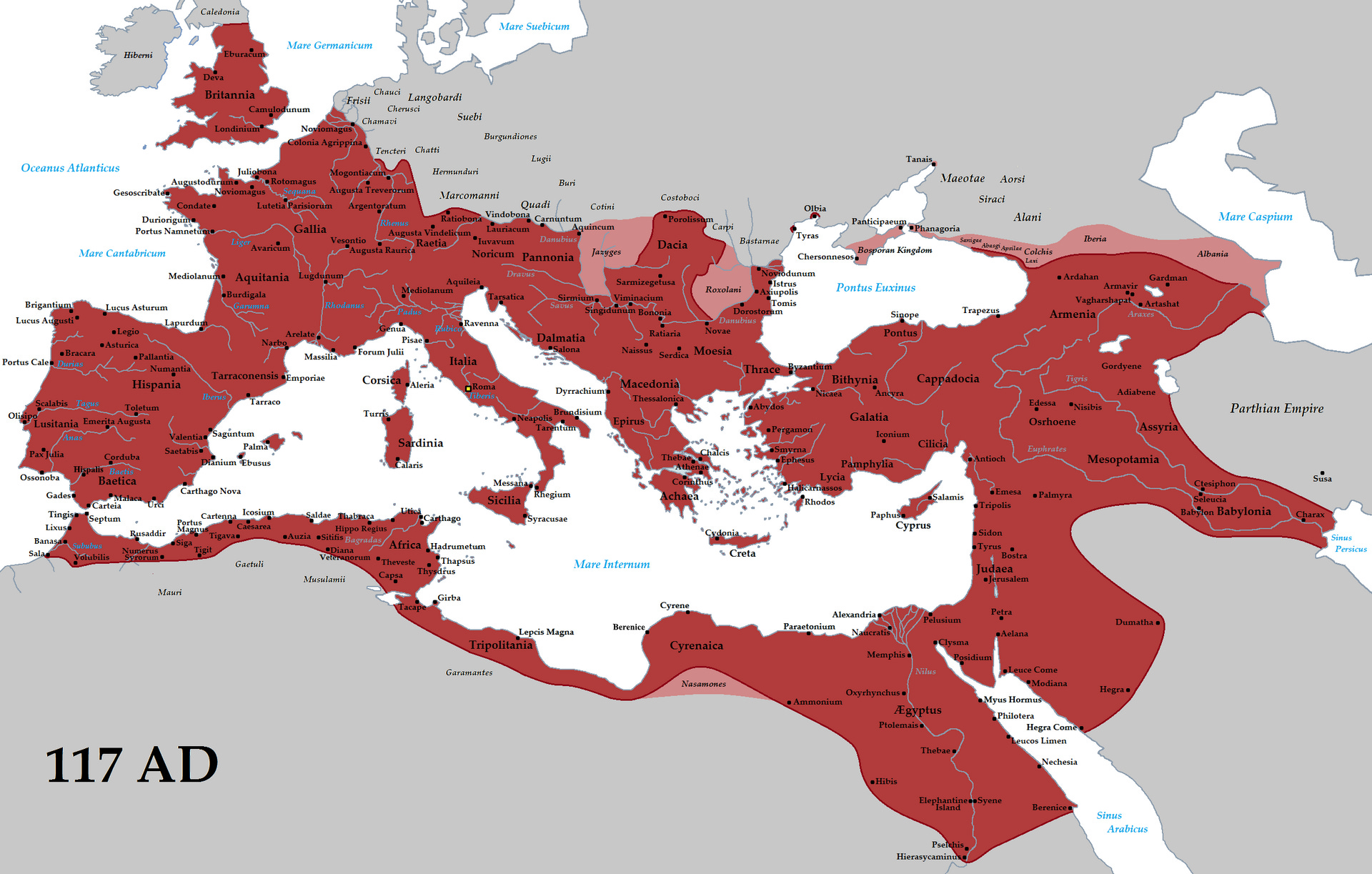
The closest term that would describe me is “Roman Hellenist”
Roman Hellenism was the largest religion in the Western world prior to the rise of Christianity. It was followed from Britain to Greece, from Spain to Romania, and was the first civilization-wide faith for Europeans.
At its height under the Roman Empire, Hellenism was a vast and adaptable religious tradition that united Greek mythology, Roman state religion and cults, household rites, and philosophical schools into a coherent spiritual world. As the organized state religion, the Dii Consentes were worshipped in every corner of the empire under both Latin and Greek names. Jupiter, Mars, Venus, Apollo, Minerva, and others were honoured through public festivals, imperial temples, military devotions, and local folk religion. This civic devotion was shaped by writers such as Cicero, Livy, and Plutarch, who emphasized the importance of piety, order, and divine ancestry.
Hellenism offered more than just myth or folklore. It provided a structured understanding of the cosmos, where the gods represented natural and moral forces, and where religion was interwoven with daily life, civic duty, and personal virtue. Mystery cults such as those of Dionysus and the Eleusinian rites offered deeper initiatory experiences, described by authors like Herodotus and Euripides. Philosophers such as Plato, Plotinus, Porphyry, Iamblichus, Proclus, Damascius, and Hierocles were considered divinely inspired and were often trained by the augurs, or in the College of Pontiffs, established in 400 B.C., and the inspiration for the College of Cardinals. These were priests within the state religion.
They built the theology of the faith. These philosophers were not monotheists or atheists, but pagans, and their theology came from Hellenism. Ordinary people prayed, sacrificed, and kept sacred fires at home. This marks the distinction between the folk religion of the everyman and the theological work of the priestly and philosophical elite, though they formed a whole, similar to Christian folk religion compared to the sophistication of the clergy. Hellenism in the Roman world was participation in a divine order that shaped identity, politics, culture, and destiny.
It had a core, but it was a dynamic tapestry. It often accommodated or incorporated local and regional gods of subject peoples throughout the empire, including other Europeans. It was normal to find shrines or temples dedicated to syncretic deities where Roman and provincial traditions were blended. This reflected a deeper truth shared by many Indo-European peoples. Across vast distances, from the Celts and Germans to the Greeks and Romans, there was a common spiritual grammar. Their gods often held similar roles, attributes, and origins. Rather than destroy or suppress local belief, Roman Hellenism often absorbed and integrated it within a universal metaphysical framework, though one without too strict of a dogma, which allowed spiritual continuity across cultures.
The Romans referred to this process as interpretatio graeca, the identification of foreign gods with Greek ones, and interpretatio romana, the application of Roman names and attributes. In Gaul and Germania, local deities such as Lugh or Wodan were equated with Hermes or Mercury. Camulos and Tyr equated with Mars, Taranis with Jupiter through interpretatio gallica and interpretatio germanica.
These interpretive traditions allowed theological bridges across linguistic and ethnic boundaries, fostering religious continuity and civic unity. Writers like Varro, Tacitus, and Strabo observed this continuity, noting that while names and symbols differed, the gods themselves were one in essence. This interpretive unity was ritualized practically in temple, altar, hymn, and law.
This faith, was shaped by the Iliad and the Aeneid, the rituals of Rome and the hymns of Orpheus, the Chaldean Oracles, the laws of the Twelve Tables and the meditations of Aurelius. It spoke through the Sibyl and the Stoic, the philosopher and the priest, the hearth and the polis. It is the soul of the West in its first religious form, a religion of cosmic order, virtue, memory, and return. Its path leads from the One to the many, and back again through sacrifice, contemplation, and union.
To be a Hellenist, in this fuller sense, is to honour the gods as real beings and divine intelligences who participate in the life of the soul and the order of the cosmos. It is to seek harmony with this order through philosophy, ritual, moral striving, and ancestral memory. It is a way of life, rooted in reason and reverence.
III. The Gods
I believe in the Dii Consentes or the Olympians, that is, the Greco-Roman pantheon. These gods are living, divine intelligences. They represent the primary cosmic order, each governing aspects of existence that are both natural and moral, divine exemplars and forces of cosmic balance. Their names differ in Latin and Greek, but their essence remains consistent across time, culture and language.
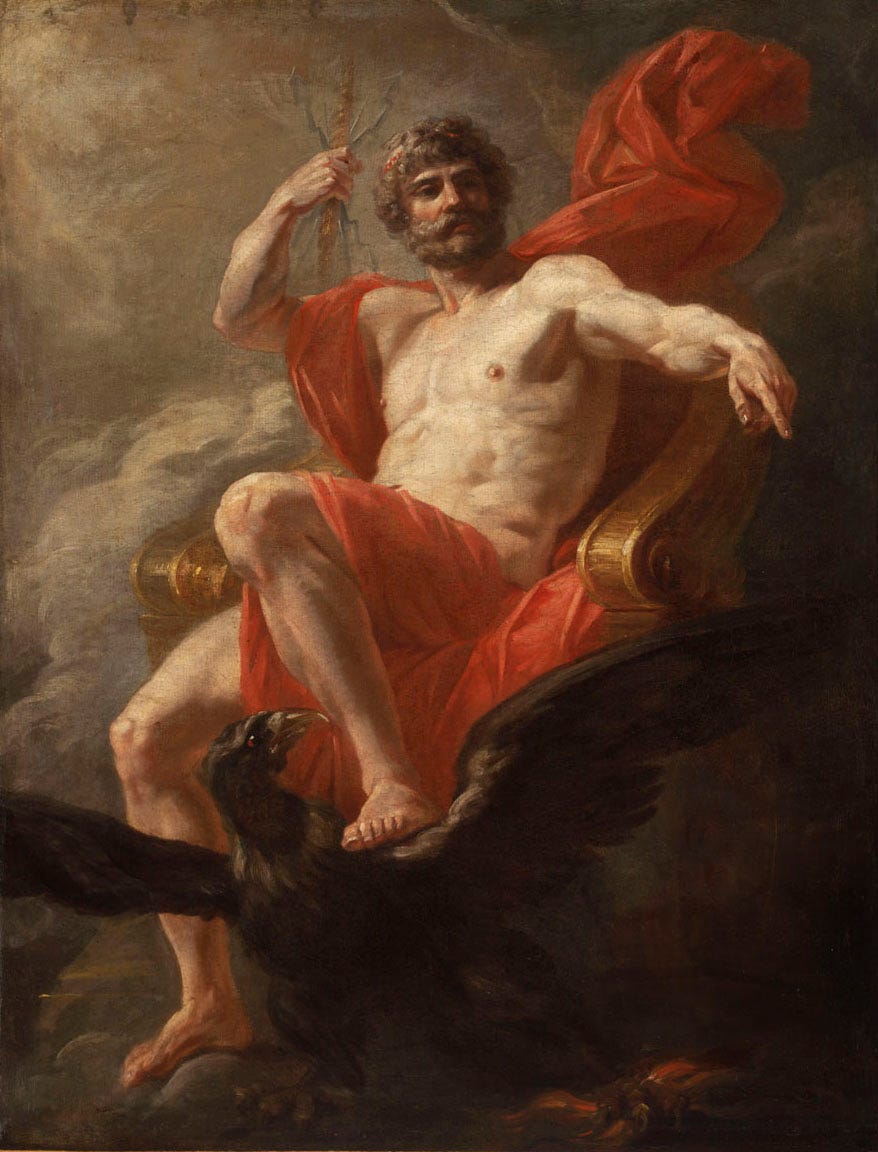
Jupiter (Zeus): King of the gods, wielder of the thunderbolt, guardian of law, oaths, and justice. He is the visible face of cosmic order, the mind that governs fate, the Demiurge who imposes structure on the world. His will is law, his sign the eagle, his realm the heights of Olympus. In The Iliad, he weighs destinies. He is the rational principle who holds the cosmos together.
Juno (Hera): Queen of heaven, protector of marriage and sovereignty. She governs the sacred bonds between families, peoples, and oaths. To the Latins, she is the Juno Regina, honoured by matrons and invoked at childbirth. She reflects divine majesty and maternal strength, the stabilizing presence of divine feminine will.
Neptune (Poseidon): Lord of the sea, earthquakes, and horses. He commands the fluid, untamed forces of the deep. Mariners, seers, and colonists honoured him in coastal sanctuaries. In Hesiod, he stands among the three great sons of Cronos. In metaphysical terms, he expresses the powers of generation and destruction within nature.
Minerva (Athena): Goddess of wisdom, war’s strategy, and crafts. She emerges fully armed from the head of Zeus, the embodiment of rational power and divine intelligence. In Athens she ruled not only battle and weaving, but civic virtue, philosophy, and sacred law. Her owl is the sign of inner sight. She is honoured wherever thought and discipline reign.
Mars (Ares): The god of war, blood, and courage. In Roman religion, Mars was not only destructive, but the father of the Roman people. He was invoked before battles, honoured by legions, and given sacred fields for ritual and sacrifice. He represents the necessary force that defends order and tests manhood. In the chain of being, he is the fire of separation and movement.
Venus (Aphrodite): Goddess of love, desire, beauty, and union. She is the power of attraction that binds all things, from mortals to gods. In Hesiod’s Theogony, she is born from seafoam; in Roman tradition, she is the divine ancestress of Aeneas. Her realm is not limited to the sensual, but is also cosmic, drawing all souls back toward harmony through longing.
Apollo: God of light, prophecy, music, medicine, and truth. Called by the same name in both languages, Apollo is the golden harmonizer of opposites. He reveals the divine will through the Delphic oracle, inspires the lyre and the mind, and purifies the soul. H is the god who orders Logos and calls the soul to its origin.
Diana (Artemis): Goddess of the wild, the hunt, the moon, and the young. She protects the cycles of life and death, guarding both birth and virginity. Her rites were held in sacred groves and moonlit fields. In her, the wilderness is divine, not chaotic. She is the guardian of transitions, thresholds, and untamed virtue.
Vulcan (Hephaestus): God of fire, forge, and craftsmanship. He works beneath the earth, shaping divine tools and celestial order. His fire is creative, not consuming. The Roman Vulcanalia honoured him as protector against destructive flame. Metaphysically forge symbolizes the soul’s shaping within the material world, at behest of Jupiter, the Demiurge.
Vesta (Hestia): Goddess of the hearth and the sacred flame. She is the quiet centre of both home and state. In Rome, the Vestal Virgins tended her fire, a symbol of the eternal presence of the gods within the civic soul. She is first in sacrifice and last in prayer, for all begins and ends in her stillness. She is the sanctifier of domestic and public piety.
Mercury (Hermes): Messenger of the gods, patron of travellers, merchants, orators, and thieves. He guides souls to the underworld and carries prayers upward. He is swift, liminal, and cunning. In esoteric rites, he is the guide of ascent and the guardian of hidden truths. He wears winged sandals and carries the caduceus, symbol of balance and mediation.
Ceres (Demeter): Goddess of grain, harvest, and maternal abundance. Her grief for Persephone brings winter; her joy, spring. She governs the fertility of the earth and the mysteries of life and death. In the Eleusinian rites, she reveals the soul’s passage through suffering to renewal. She is the divine nourisher, both physical and spiritual.
Beyond the Twelve, other great gods were central to the mystery and metaphysical life of the faith:
Dionysus (Bacchus): God of ecstasy, wine, divine madness, theatre, and rebirth. He liberates the soul from the confines of form, dissolving boundaries through sacred frenzy. His rites were held in mountains and under torches, where mortals became enthousiasmos, or filled with god. The Orphics called him Zagreus, torn and reborn. He is the soul’s dismemberment and reunion.
Helios: The sun god, who drives the chariot of day and sees all things. He is light as intellect, sun as divine consciousness. Cosmologically, Helios is a manifestation of Nous, the perfect Form shining through the visible world. In Roman rites, he was worshipped as Sol Invictus, the Unconquered Sun.
Saturn (Cronos): The god of time, fate, and the golden age. Though overthrown by Jupiter, he remains honoured in rites like the Saturnalia, when the old order is reversed and the past is remembered. He is the necessary limit that gives shape to life. In esoteric terms, he represents the soul’s bond to time, to be transcended through ascent.
The Chthonic Gods: Pluto (Hades), Persephone (Proserpina), and Hecate govern the underworld and the mysteries of death, rebirth, and spiritual transition. Their rites are nocturnal, their offerings buried or burned in black vessels. They are not evil, but necessary guardians of the soul’s passage. In both Orphic and civic cults, they were venerated at tombs, crossroads, and hidden altars.
These gods, whether Olympian, chthonic, or mystery-based, were intimately present in civic life, household rituals, and the inner world of the soul. Worshipped through sacrifice, hymns, libations, festivals, and processions. Their myths encoded metaphysical truths, moral guidance, and the deep structure of reality, invoked in birth, marriage, travel, battle, agriculture, and death. From the Iliad to the Orphic Hymns, from Hesiod’s Theogony to the Neoplatonists’ cosmology, these gods appear as radiant presences in both story and sacrament.
The gods are not jealous competitors with each other or with the soul. They are the many faces of order reflecting a sacred cosmos structured by harmony, where each being has its appointed role. Through virtue, theurgy, philosophy, and piety, we draw near to them, honouring their presence and aligning our souls with their divine rhythm.
The Middle Spirits: Daimons, Lares, and the Living Cosmos
Between the gods and mankind exists a vast class of spiritual beings known as the middle spirits. These include daimons, heroes, nymphs, genii, Lares, and other nature spirits. These mediate between the mortal and divine worlds. Their presence fills the cosmos with sacred life, ensuring that every hill, river, home, and human soul participates in the divine order. This belief was a universal doctrine found in temples, homes, and philosophical schools. In Theogony, Hesiod describes the birth of countless divine and semi-divine spirits from the primordial gods, populating the earth with living presences. Plato and Plutarch speak of the daimons as guardians of the soul, while Iamblichus and Proclus treat their invocation as central to theurgy. The Orphic Hymns invoke them with libations and sacred formulae. The Romans, too, revered these spirits as essential to family, city, and empire.
Daimons are guardian spirits assigned to individuals at birth. This belief, found in Plato, Plutarch, Iamblichus, and Proclus, was central to religious psychology. A person’s daimon was not a metaphor for conscience. Every soul, according to Plato in Phaedrus, is assigned a personal daimon at birth. These beings accompany mortals throughout life, offering warnings, insight, and moral guidance. Socrates himself referred to his daimonion, an inner voice that restrained him from error. It was a real spiritual companion who oversaw moral development and destiny. The daimon inspired dreams, warned of danger, nudged the soul toward its better nature, and mediated between the person and the gods. In Christian theology, this figure reappeared as the guardian angel, though the concept itself is far older.
Heroes are souls of mortals who, through extraordinary virtue, suffering, or divine favour, attained semi-divine status. Figures like Heracles, Aeneas, Romulus, Hector of Troy, and some Roman emperors who achieved apotheosis were venerated in both myth and cult. They received offerings, had temples, and were honoured with festivals. Heroes could guard cities, protect families, or act as ancestral patrons. As seen in the Aeneid, the hero Aeneas is not just a founder, but an instrument of fate (fatum) and divine will. Heroes are honoured in heroic cult as intercessors with the divine and examples of mortal excellence fulfilled. Iamblichus taught that heroic souls had transcended human limitation but had not yet merged with the purely divine. It dwelled in the liminal spaces of the cosmos, capable of both divine insight and human sympathy.
Nymphs are the feminine spirits of nature. They dwell in forests, rivers, springs, caves, and trees. Nymphs are not poetic symbols of the wild. They are spirits whose blessings or wrath affect the land and its people. In Hesiod, Homer, and the Orphic Hymns, nymphs are addressed as divine beings, deserving of libations, songs, and respect. To harm a nymph’s grove or to pollute her waters was to risk spiritual retribution. In return, nymphs brought fertility, guidance, prophecy, or protection. The Homeric Hymns speak of nymphs who accompany Artemis in her hunts and dance with Dionysus in ecstatic rites. In the mysteries, especially of Dionysus and Eleusis, nymphs play a role in guiding the soul through nature’s life-death-rebirth cycle. They are the living soul of place, localised manifestations of the World Soul (we’ll get to that), who sanctify land and water, grove and spring.
Genii (plural of genius) were central to Roman religion. Every person had a genius, a guardian spirit of one’s nature and fate. Men had genii, women were said to be guarded by a Juno. The genius of a family was honoured at household rites. The genius of the emperor was worshipped publicly as a sign of loyalty to the sacred order of Rome. Similarly, cities, provinces, and even military units had collective genii. These spirits governed the health, fate, and character of the entities they oversaw. They were honoured with incense, wine, and formal oaths.
Lares were household spirits connected to the dead. Often sometimes considered deified ancestors or guardian daimons of the family line, the Lares protected the hearth, the threshold, and the continuity of domestic life. Their shrines stood in kitchens, doorways, or near the hearth, where daily offerings were made. They were invoked during rites of passage, during meals, and before leaving or returning home. Roman piety was deeply structured by the cult of the Lares, whose presence bound the living to the dead and the household to the divine.
Other spirits—dryads, oreads, naiads, and similar nature beings—completed this world of sacred intermediaries. Every part of the natural world was inhabited by its own guardian spirit. As the Chaldean Oracles taught, no part of reality is uninhabited. This is not animism, but a cosmological understanding: that the divine reaches every level of creation, and that even a stone, a stream, or a tree may be hallowed by its participation in the divine chain. The gods dwell in the heavens, but they also speak through the whispering of leaves, the silence of tombs, and the shadows of twilight.
The middle spirits are present in every stratum of ancient religion. They are named in Hesiod’s Theogony, revealed in the Orphic Hymns, invoked in Platonic dialogues, honoured in Roman ritual, and interpreted through Neoplatonic metaphysics, filling the world with divine presence and act as living thresholds to the upper realms.
In the metaphysical hierarchy, they dwell just below the major gods and above mankind. They operate as guardians, testers, and companions of the soul, often determining whether a person is fit to ascend. Some may appear in dreams or visions, others in ritual or inspiration. They inhabit the forests, crossroads, groves, shrines, and domestic altars of daily life. Their honour and recognition are essential to right religion. Without them, the sacred order is severed at its middle rung.
As Proclus writes, “These divine spirits maintain the harmony of the universe, linking all beings in the golden chain of return.” In this vision of the cosmos, there is no such thing as emptiness or dead matter. All things live and move in relation to the divine. The world is a temple, populated by beings more ancient, more intelligent, and more enduring than man. These spirits do not compete with the gods. They serve them, reflect them, and extend their governance into the most intimate corners of daily life.
Humanity: The Rational Soul in the Cosmos
Human beings are not creatures of earth and matter. They are rational souls descended from the divine order, born into mortal bodies for the purpose of purification, virtue, and return. In both myth and philosophy, humanity is depicted as a unique being, situated between gods and beasts. Unlike the daimons, who are fixed in their nature, or animals, who lack reason, human souls are dynamic, capable of rising toward divinity or falling into ignorance and dissolution.
Plato’s Phaedrus and Phaedo affirm the soul’s immortality, its divine origin, and its descent from the heavens. In Phaedrus, the soul is described as winged, once soaring among the gods before falling into incarnation due to forgetfulness. The goal of life is to sprout those wings again, through philosophy, a, virtue, and recollection of the divine truths once beheld in Nous. The Chaldean Oracles echo this: “Man is a divine animal, bound in flesh, who must remember the path of return.”
Myth reinforces this truth. In The Iliad, heroes are not only warriors but moral agents under the gaze of Zeus, whose justice shapes their fate. Achilles’ wrath, Hector’s duty, and Priam’s piety are not moral abstractions but real events judged within the cosmic order. The Orphic Gold Tablets, placed with the dead in graves across the Hellenic world, speak of the soul’s journey after death: “I am a child of Earth and starry Heaven, but my race is of Heaven alone.” These tablets guided the soul through Hades, affirming its divine origin and ultimate destiny.
The Eleusinian Mysteries, initiates were taught that the soul, like Persephone, descends into darkness but can rise again into light. The myth of Demeter and Persephone enacted truth of the soul’s cyclic journey through life, death, and rebirth. Cicero later wrote of the Mysteries: “They taught us not only how to live with joy, but how to die with hope.”
Virgil’s Aeneid portrays this process in Roman terms. Aeneas is not a wanderer, but one chosen by fate—fatum—to found a divine order. In Book VI, Anchises reveals to Aeneas that souls are purified in the underworld and reborn, unless they achieve final liberation. This doctrine, mirrored in Pythagorean and Orphic teachings, affirms that human destiny is governed by moral purification, not arbitrary judgment.
Human faculties reflect the divine structure. Our rational intellect partakes in Logos, the principle of order. Our contemplative soul aligns with Nous, the realm of eternal Forms. Our moral will reflects the unity and goodness of the One. This was taught as religious truth. Hierocles, Iamblichus, Plotinus, and Proclus all affirmed that the purpose of human life is to become like the divine—homoiosis theo—through justice, moderation, courage, and wisdom.
Ethics was never abstract. It was a sacred way of life. Seneca and Marcus Aurelius taught that to live justly was to live according to nature, which is to say, in harmony with divine order. The mos maiorum, the ancestral virtue of the Roman people, preserved this truth in civic life. Piety, courage, loyalty, and restraint were not social conventions. They were paths of ascent.
Humans are microcosms of the whole cosmos. As taught by the philosophers and expressed in myth, each human contains all levels of the chain of being, material, vital, rational, and divine. Our descent into body is a trial and opportunity. Through right action, memory, and ritual, the soul may ascend once more, restoring its harmony with the gods. This is why, as Julian wrote, “the goal of philosophy is not speculation, but the purification and perfection of the soul.” The gods do not demand submission, but participation. They are intelligences who guide, witness, and reward the soul’s return.
Humanity is a sacred middle term in the divine hierarchy. Born from the stars, dwelling in the body, and destined for return, the human soul stands at the threshold of two worlds. Its task is not to deny the world, but to harmonize it. Through virtue, ritual, remembrance, and divine contemplation, it may rise—step by step—toward its origin in the One. This is not metaphor. It is the reality of every rational soul.
IV. Myth, Cosmos, and Divine Order
The Afterlife
In the Hellenic tradition, the soul is immortal and eternal. It preexists the body and descends into generation as a trial, a learning, and a purification. The soul’s goal is to return to its divine source through a process of purification, ascent, and union. This belief was held widely across Greek religion, from Homeric poetry and Orphic mystery rites to the highest philosophical schools.
According to the Orphic Hymns, the soul is a divine spark that has fallen into the world of becoming and must return to the world of being. The hymns speak of Dionysus, Zagreus, and Persephone as central figures in this mystery: the soul is torn apart, scattered in matter, and later reassembled through divine rites. The initiate, by imitating this divine cycle through ritual purification, hymn, and sacrifice, undergoes rebirth.
In Hesiod’s Theogony, we see the mythic structure that undergirds this cosmology: the descent from primordial Chaos, the generation of Gaia, Uranus, and Kronos, and the eventual rise of Zeus. This procession is echoed philosophically in the chain of being. The gods in Theogony do not exist in contradiction to the metaphysical One, but as its manifest intelligences within the mythic and cosmic order. As Proclus understood, myth expresses eternal truths in symbolic form. The battles between gods, the descent of Persephone, the castration of Uranus, all become symbols of metaphysical processes: separation, individuation, and return.
The Iliad presents a world filled with divine agency. Gods walk among men, intervene in fate, and dwell in both the heights of Olympus and the underworld. In this epic, the soul of a hero does not vanish into nothingness but continues to exist in Hades. Achilles’ encounter with Patroclus in Book 23, and his conversation with the shade of Agamemnon in The Odyssey, show a world where the dead still think, speak, and interact. These passages lay the groundwork for later philosophical interpretations of soul continuity and destiny.
According to Plato’s Phaedo, the soul that pursues wisdom and virtue through its life is not bound to the cycles of reincarnation but is released to dwell in the realm of the Forms. The Phaedrus describes the soul as a winged charioteer drawn by two horses—one noble, the other base—and presents the upward path as a struggle toward divine vision and eternal beauty. These teachings were taken up and deepened by Plotinus and Proclus, who saw philosophy, purification, and theurgy as the means of ascent.
When the soul departs the body, it is judged not by a personified deity alone, but by the measure of its own harmony with the divine order. As taught in the Chaldean Oracles, and echoed in Iamblichus and Proclus, souls that have lived with virtue and piety are able to ascend through the planetary spheres, shedding the influences of fate and materiality. They are guided by gods and daimons, until they reach the realm of pure intelligibility. If the soul is unpurified, it returns through cycles of rebirth, often into new human lives, or sometimes into the bodies of animals. This reincarnation is not random, but governed by cosmic justice, in accordance with the soul’s prior deeds and inclinations.
Some souls, according to Orphic and Platonic teaching, dwell for a time in the Elysian fields—a region of light, memory, and joy—before continuing their ascent. Others remain longer in Hades, in realms of forgetfulness and shadow, undergoing correction. Yet even here, the gods provide guidance and possibility. Hecate, Hermes, and Persephone are all guardians of the dead. Offerings to the chthonic gods, libations at tombs, and remembrance of ancestors all serve to support the dead in their journey and maintain harmony between the worlds.
The afterlife is not a binary judgment, as in later Christian thought, but a complex and graduated realm where the soul’s condition matches its spiritual state. Justice is exact and unyielding, but not vindictive. Divine mercy exists in the opportunity for return, remembrance, and the path of theurgy. The ultimate goal is henosis, the reunification of the soul with the divine source, the One, beyond multiplicity, where all things become one again.
Creation and Cosmology
Creation in the Roman Hellenism is not ex nihilo, from nothing, as in later Abrahamic thought, but ex divino, out of the divine. The universe emerges through ordered procession from the eternal source, not as a moment in time, but as a continuous unfolding of divine reality. The ancients did not envision a singular moment of creation, but rather a metaphysical hierarchy that eternally flows outward from unity toward multiplicity and back again. This process was poetically expressed in Hesiod’s Theogony and ritually in the Orphic Hymns, then later clarified by the metaphysical precision of Plato’s Timaeus, Phaedo, and Phaedrus, and fully systematized by Plotinus, Iamblichus, and Proclus.
In the Orphic Hymns, all things begin with Phanes, the first-born light and primordial god who emerges from the cosmic “egg”. This radiant being contains within himself the seeds of all gods and beings. He is sometimes identified with Eros, the generative force, and also with Dionysus, in whom the cosmos is mystically dissolved and reborn. Phanes is both a god and a principle, the first intelligible emergence of multiplicity from the silent unity of the divine.
Plato’s Timaeus provides the philosophical articulation of this mythic insight. It presents a cosmos ordered by the Demiurge, Jupiter/Zeus, the divine craftsman, who brings order to the chaotic potential of matter by imprinting it with the eternal Forms found in Nous, the divine intellect. The Demiurge does not create arbitrarily, but with absolute goodness, shaping a living universe whose body is the heavens and whose soul is the World Soul. According to Timaeus, the cosmos is a single living creature, perfect and self-sufficient, revolving in harmony with the divine.
The Chaldean Oracles, highly revered by Neoplatonists, affirm this view of creation as the procession of being from unity into diversity. They speak of the divine fire, the intellectual light, and the triadic structure of reality—rooted in the ineffable One, expressed through Nous, and animated through Soul. The gods are described as rays of the divine sun, each emanating specific powers and functions. The universe isn’t a fallen place but a theatre of ascent and return.
Plato’s Phaedo and Phaedrus both explore how the soul is bound to this cosmos and participates in its order. The soul is immortal and pre-exists its embodiment. It descends into a body through forgetfulness and is tasked with remembering the divine Forms. In Phaedrus, this descent is described as a fall from the chariot of the gods, where the soul loses its wings and becomes heavy with flesh. Yet this descent is not a punishment but a trial, an opportunity for the soul to regain its wings through beauty, love, and contemplation.
Matter, or hyle, exists at the furthest end of the chain of being. It is pure potentiality, not evil in itself, but in need of divine form to become intelligible. The Demiurge contemplates the intelligible order and impresses it onto this material substrate, producing the cosmos as a living reflection of the eternal. Time itself is a moving image of eternity, measured by the heavenly bodies and the rhythm of nature.
Creation is thus not merely the beginning of things, but the constant presence of divine order. Every part of reality, from the highest god to the smallest plant, participates in the divine. The stars move in perfect harmony because they obey the will of the divine intellect. The seasons cycle because the World Soul breathes through the land. Even death is part of this process, a return and renewal within the sacred order.
This worldview, upheld by the Orphic Hymns, Chaldean Oracles, Timaeus, and the writings of the Neoplatonists, is not a myth opposed to reason. It’s a mythic rationality, a metaphysics that unites myth, ritual, nature, and soul in a single living cosmos. The universe is neither a machine nor a prison, but a divine being to be loved, studied, and reverenced.
The Chain of Being
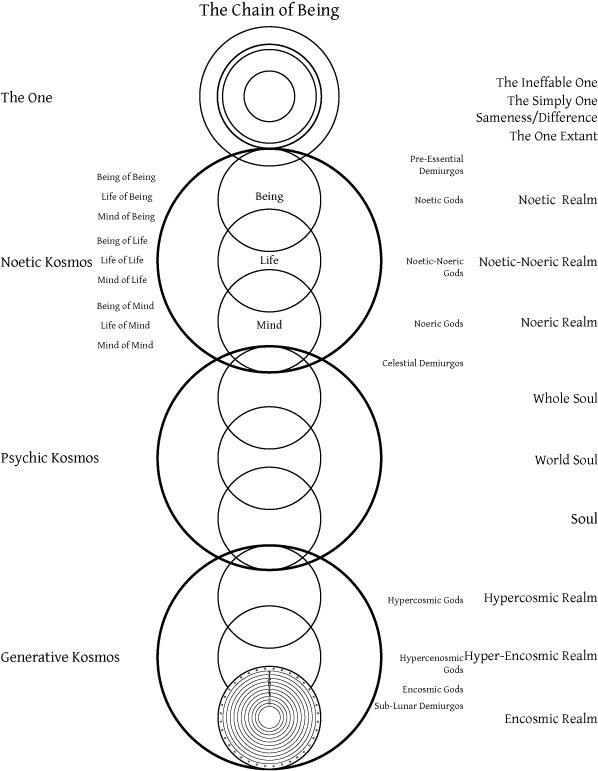
The cosmos is not governed by blind force. It is a divine hierarchy, a structure of procession and return known to the ancients as the chain of being. Every level flows from the one above it, not by distance, but by participation. Each thing that exists receives its nature from the divine and seeks to return to its source through worship, virtue, and contemplation. This is not only metaphysics. It is theology. It is taught by myth and enacted in liturgy.
How the Chain of Being works
At the summit stands the One, the Monad. It is the origin of all, beyond thought and beyond being. It is not a god among others, but the ground of divinity itself. As the Chaldean Oracles declare, all things subsist in the One. From this source all proceeds, yet it remains unchanged. It is honoured not by name, but by the soul’s ascent toward unity.
From the One proceeds Nous, the divine intellect. This is the realm of eternal Forms, the principles by which all things exist. In the Timaeus, the Demiurge contemplates this realm to form the cosmos. In the Theogony, the generations of the gods mirror this order as it unfolds. The gods in their highest aspect dwell here, as pure intelligences, radiant and eternal. The Olympians, as shown in The Iliad, are reflections of this reality shaped for mortal understanding.
From Nous proceeds Logos. Logos is not a god. It is the principle of reason, structure, and harmony. The Orphic Hymns speak of it as the law that governs all things. It is the cause of order, the measure of nature, and the bond that holds the cosmos together. Through it, thought becomes form, and form becomes world.
From Logos emerges the World Soul, the living unity of the cosmos. It animates the heavens and binds the temporal to the eternal. The Timaeus and Phaedrus describe it as a real being who contains all motion and gives life to the spheres. In the Orphic tradition, Dionysus mirrors this soul in his dismemberment and rebirth. The World Soul descends, suffers division, and seeks return.
Through the World Soul, the Demiurge shapes the cosmos. The Demiurge is not outside the gods. He is their king. He is identified with Jupiter, or Zeus, the one who establishes justice and gives order to all things. In the Timaeus, he forms the cosmos by impressing the Forms into matter. In the Theogony, Zeus rules through fate and law. In the Chaldean Oracles, he brings order to chaos by divine command.
From the Demiurge proceed the gods. These are not metaphors. They are real powers. The Dii Consentes, or Olympians, and other divinities are active intelligences who govern all aspects of life. Each one embodies a reality. Aphrodite governs desire. Athena governs wisdom in battle and craft. Apollo orders music and prophecy. In the Timaeus, they shape the human soul. In the myths, they reveal the sacred law of nature.
Beneath the gods are middle spirits: daimons, genii, heroes, and nymphs. These beings mediate between the mortal and the divine. They are named in the Theogony, where the children of Night reflect hidden aspects of existence. In Phaedrus and Symposium, daimons carry divine messages and shape the soul’s fate. The Orphic Hymns invoke them in every domain of life. Iamblichus affirms their role as guides. Roman religion preserves them as household and civic protectors. They are not poetic ideas. They are presences.
Then come rational souls, human beings. The human soul reflects the order of the whole. It receives Logos, contemplates Nous, and longs for the One. It is placed in a body for testing and transformation. Phaedrus speaks of its fall and its return through love and memory. The Orphics describe it as divine, trapped in matter, but capable of ascent. Man is not a beast, nor a god. He may rise or fall. This makes him sacred.
Below humanity are irrational souls: animals and plants. These have life, but not reason. They are shaped by divine order, and their beauty, instinct, and sacrifice reflect their place in the cosmos. The Orphics and Pythagoreans teach that some souls pass through these forms during rebirth. They are not fallen, but limited.
At the bottom lies matter. It has no form of its own. It is shaped by the Forms but cannot shape itself. Plotinus calls it the shadow of being. It is not evil, but it is furthest from the divine. Even here, form gives it structure. The Demiurge imposes order. Chaos is excluded.
The chain of being is a single procession. From the One to matter, each level reflects the divine and participates in its return. This is the foundation of Hellenist theology. Plotinus, Iamblichus, and Proclus teach it clearly. But it is also in the Timaeus, the Orphic Hymns, the Theogony, and the epics. It is behind the rites of Eleusis. It explains the myths of Homer. It is the grammar of the sacred.
Neoplatonism is not a foreign addition. It is the natural unfolding of Hellenic religion. It reveals the structure behind the cult. It does not replace the myths. It explains them. It shows how the gods, the rites, the hymns, and the soul belong to one eternal order.
The Soul & the Path of Ascent
The soul is eternal. It enters mortal life from the divine realm, marked by the imprint of the intelligible world and the memory of the gods. This descent is not a fall, nor is it a curse. It is a test of integrity and orientation. The soul must return, and it does so through sanctification. The cosmos itself is the frame of return. It is a living hierarchy through which the soul ascends by philosophy, piety, sacred rites, and ancestral fidelity.
Plato’s Phaedrus and Phaedo describe the soul’s immortality and its movement through birth, death, and rebirth. In Phaedrus, the soul is shown as a charioteer who remembers the Forms and regains wings. In Phaedo, death is not an escape but a purification. The soul that lives with justice and understanding may depart to dwell among the blessed. This ascent is not spatial. It is ontological. The soul must shed confusion, desire, and division in order to recover its place.
This doctrine is echoed in the mysteries of Dionysus and Eleusis, and in the Orphic tradition. The soul is bound to a cycle of lives until it becomes clean. Sacred rites, hymns, and ethical discipline bring the soul closer to judgment. Its goal is not to flee the world but to complete its pattern. The order of the divine is already present here. The task is to become worthy of it.
The Chaldean Oracles, preserved through Neoplatonic schools, provide a structured map of ascent. They teach that divine union requires sacred action. Theurgy is not pageantry. It is not abstract symbolism. It is an actual bond with the gods. Through invocations, gestures, and offerings, the soul meets the divine intelligences who sustain the world. The gods do not enter matter, but they meet the soul through forms that reflect their nature. When performed in right order, these rites elevate the soul toward its source.
Ascent begins with purification. Hierocles taught that courage, temperance, justice, and understanding are the first steps. These virtues are not speculative. They exist in the real world. They are shaped by household roles, civic duty, and inherited tradition. In the Roman world, this order was known as mos maiorum, the way of the ancestors. It was more than custom. It was a divine model for life. By protecting the family, serving the city, and honouring the gods, the soul grew stable and capable of return. The father of a household, the magistrate, the priest, and the soldier each took part in this order when their duties were rightly fulfilled.
The soul moves in stages. It begins with appetite, then reaches clarity, then contemplation. Its final goal is union. The Greeks called this anagoge. Its end is henosis. This ascent is expressed in different forms—myth, rite, and reason—but all lead upward. They are not separate paths. They are parts of one sacred climb.
At death, the soul is judged. The Orphic tradition speaks of this judgment as correction, not punishment. The soul is received by Hades and Persephone. Some are returned to the world. Others are welcomed to the Elysian Fields, a realm of divine joy and memory. The tablets buried with Orphic initiates contain guidance for the soul in that moment. These teachings appear again in Phaedo, and they are completed in the later work of Plotinus, Iamblichus, and Proclus.
To rise is the purpose of life. The soul is not cast into matter. It is sent. It is shaped in this world and called to remember its origin. Through virtue, tradition, and sacred participation, it becomes capable of return. Its journey is not flight. It is alignment.
A man is not born in sin. He is not abandoned by heaven. He begins as a soul in a body, placed in a world that reflects the order he comes from. He is not foreign to it. He belongs to it by nature. He does not need to be saved. He needs to live well. The gods are present. The ancestors remain. The order of being still calls. To follow it is to ascend.
V. Ritual, Cultus, and Practice
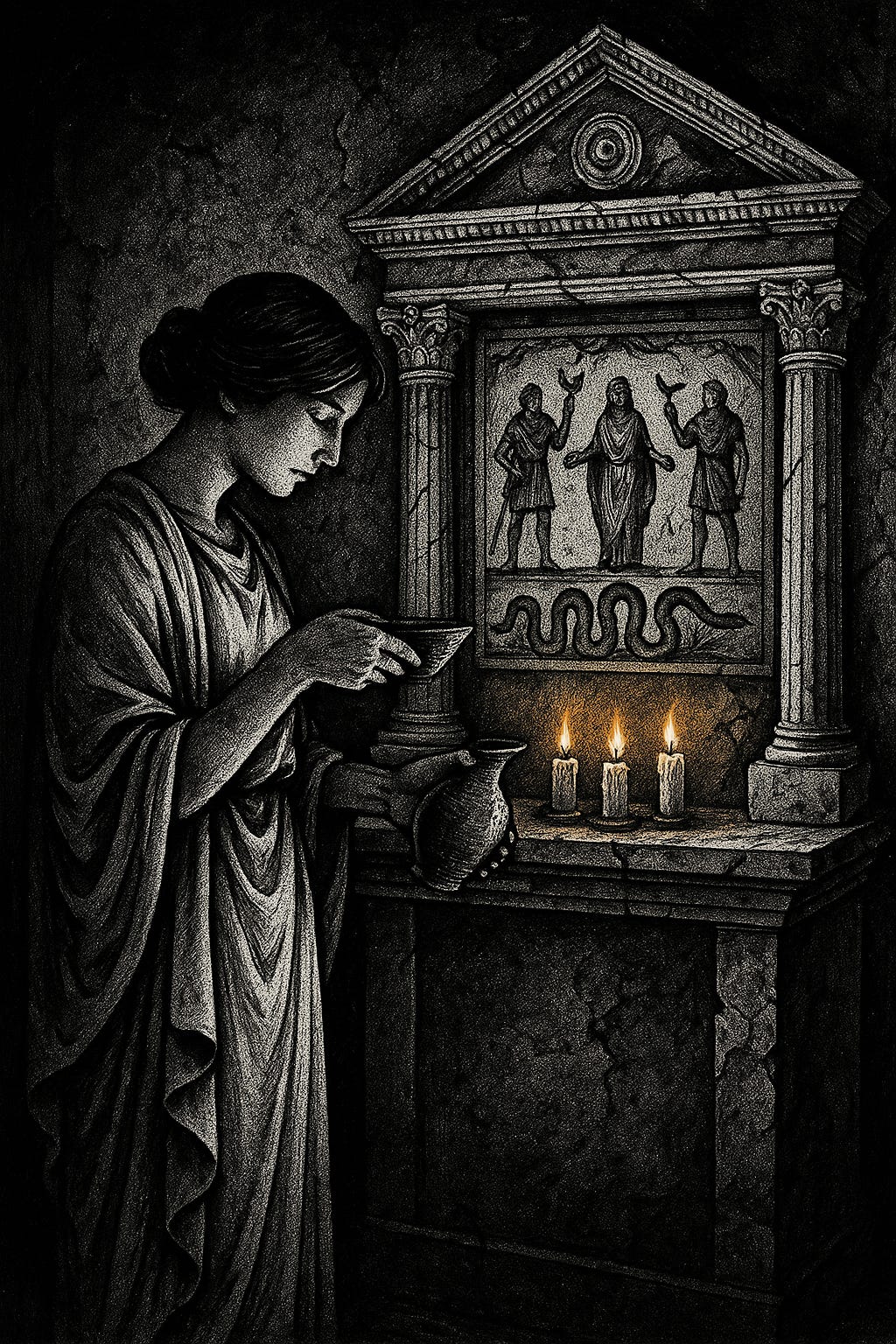
Religion is not belief alone. It is action. It is the deliberate shaping of life in accordance with divine order. In the Hellenic and Roman tradition, the sacred becomes present through daily rites, public sacrifice, and ancestral law. Cultus is not a set of gestures. It is the method by which the soul draws near to the gods and the community honours what stands above it.
Sacred Cultus
The word cultus means tending, honouring, and maintaining. It is the care of the divine through ordered action. The gods do not demand servitude. They expect reverence. Ritual is how that reverence is given. The rite calls the divine to presence. The gods answer according to the rightness of the act and the condition of the one who offers it. The rite is not symbolic. It is real. Libations, hymns, incense, and offerings are necessary patterns. They align the soul through rhythm, sound, gesture, and intention. They open the vertical path. When rightly performed, they bring the human into real contact with the gods. The principle of do ut des does not imply barter. It describes a natural order. The god grants protection. The mortal gives honour. This is not a transaction. It is an accord between levels of being.
The Lararium and the Household
The lararium is the centre of the Roman home. It is the shrine of the Lares, guardians of the house and the land. Beside them stand the Penates, protectors of the stores, and the Genius, the spiritual power of the family line. Each day, the family honours these spirits. A prayer is spoken. Food or incense is offered. A silence is held. Through this, the home joins itself to the divine. This was not private religion. It was the root of public order. The hearth mirrors the fire of Vesta. The family becomes a temple. The ancestors are remembered. The gods are present.
Classical Virtues
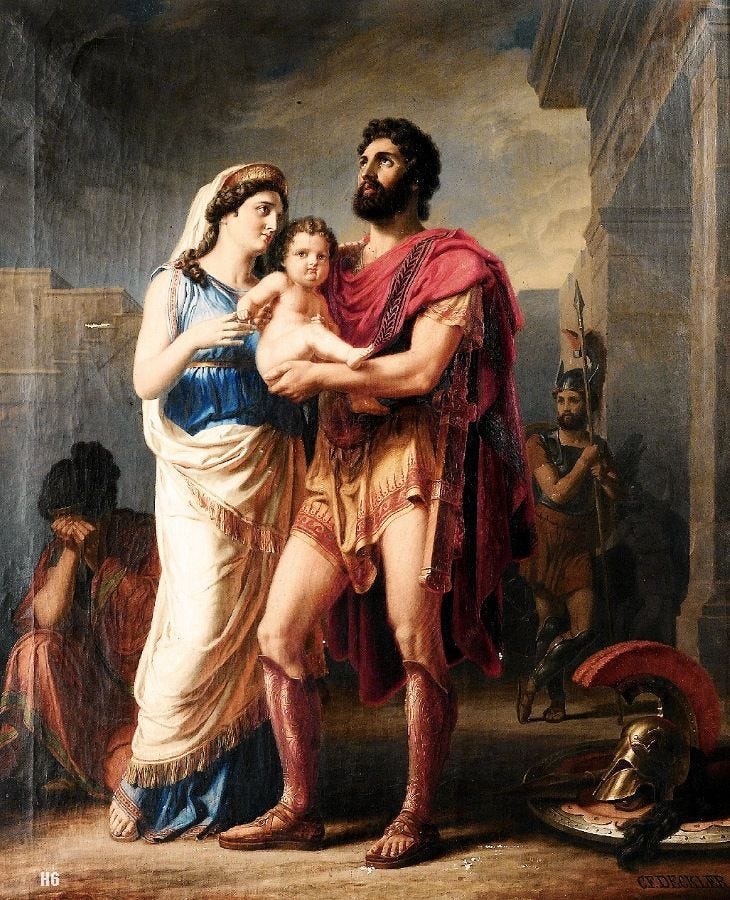
Virtue is measured by alignment with divine order and shaped by discipline, reverence, and example. The classical tradition presents the following cardinal virtues as foundations of the well-ordered life:
Sophrosyne — Temperance or moderation: the ordering of desire, the harmony of appetite, and the command of impulse.
Andreia — Courage: the strength to endure hardship, the refusal of the soul to yield to fear or shame.
Dikaiosyne — Justice: the habit of giving each his due and the restoration of proper measure in all things.
Phronesis — Practical wisdom: the faculty of sound judgment and the power to see clearly and act rightly.
These are not abstractions. They are powers of the soul, cultivated through custom, struggle, and prayer. To live them is to embody the Logos.
The Roman tradition continues this path through the ancestral virtues that shaped law, home, and city:
Pietas — Piety: the duty owed to the gods, one’s kin, and one’s homeland.
Fides — Trustworthiness: the keeping of oaths and the truth of speech and promise.
Gravitas — Earnestness: the bearing of responsibility with seriousness and resolve.
Disciplina — Discipline: the shaping of life through order, habit, and ancestral law.
Virtus — Excellence: the strength to defend, to build, and to endure with honour.
The Function of Practice
Virtue makes the soul ready for ritual. Ritual preserves the soul in virtue. Neither stands alone. The man who lives justly becomes a vessel the gods may enter. The rite without virtue is empty. The virtue without rite is incomplete. Together, they form a life of ascent. The family that honours its Lares remembers its place in time. The man who keeps pietas remembers his place in the order. The city that protects its rites does not forget the gods of its founding.
These things are not customs. They are the spine of the world.
The Ethnic Horizon of Roman Hellenism
Roman Hellenism was never a universalist religion. It arose from the religious and metaphysical grammar of the Indo-European world. This includes the Greeks, Romans, Persians, Celtic and Germanic peoples. Their traditions share a deep structural kinship by origin.
The common features across these traditions include:
A tiered cosmos of gods, heroes, and men
Fire and sky as primary symbols of the sacred
Tripartite functions of priesthood, warrior, and cultivator
Sacred law expressed through rite and ancestral obligation
The soul as a divine being called to return
Honour for ancestors as a spiritual and civic necessity
Roman Hellenism does not deny the reality of other traditions. It does not call all other faiths false. It simply preserves a sacred form meant for those who descend from its world. It speaks most clearly to those whose ancestors once walked its temples, recited its hymns, and shaped its rites. It offers a metaphysical home rather than a universal mandate.
Every people has its form. This one is mine.
V. How I became a Roman Hellenist
As I explained in the introduction, I come from an agnostic and irreligious background shaped by a culture where public displays of faith are regarded with suspicion. In Québec, secularism functions as a civic virtue. Faith itself is not always mocked, but its outward expression is often treated as backward. This outlook is not just cultural. It has become part of the political foundation of the province. The true religion of modern Québec is not Christianity. It is a secular identity cult built around French Canadian ethnicity and culture. I suspect part of what drives my deeply-rooted Canadian nationalism is this too.
Despite growing up in this world, I never became an atheist. I rejected the idea that disbelief in divinity should require the same kind of certainty as religious dogma. The insistence that the universe is empty always struck me as a blind faith of its own. I could not accept that everything was accidental or that consciousness had no origin beyond matter. When I look at nature, or the human body, I see divine creation. I usee perfectly ordered concentric circles, overlapping. At the same time, I had no model for what else might be true. Christianity was the only understanding of religion I had encountered, and that in of itself was mere embers. Its vision of God and its promises of heaven did not move me. The story of Jesus’s sacrifice did not move me.
That changed when I encountered the work of Guillaume Faye. His defense of pagan religion and his description of the pre-Christian West opened my eyes to something older and more real to me. Around that same time, I noticed a shift in the culture around me. Stoic and classical philosophy had returned to popular attention. People were reading Marcus Aurelius again. This revival of the ancients brought me to Meditations.
Reading Marcus Aurelius changed how I saw the world. He did not speak about belief or faith. He spoke about the order of nature and the moral task of the soul. He prayed to Zeus without shame in Meditations. He accepted both life and death as necessary. Through him, I saw for the first time that God could be real without what seemed like being a fantasy of comfort or fear for others. I began reading others like him. Cicero, in his works On the Nature of the Gods and On Duties, defends the existence of providence and civic piety as the heart of political life. Seneca, though more inward in tone, insists that the divine dwells in reason and that fate must be met with dignity, not resentment. These men were not mystics. They were statesmen and philosophers. Their voices were firm and rooted, they prayed standing, with their heads facing the sky, arms outstretched. They did not kneel in guilt. They stood in honour.
From there I began to trace the lineage of this tradition. The Iliad and the Odyssey. The Aeneid, the Orphic Hymns, and the Chaldean Oracles. Hesiod’s Theogony. The writings of Plotinus, Iamblichus, and Proclus. These were not primitive myths. They revealed a world in which the divine dwells in every form and action. They expressed a metaphysical structure that answered the longings of the soul. In them I found an rational order of reality in which honour, fate, and virtue had meaning.
In time I also had personal experiences that confirmed what I had come to believe. These are difficult to speak about. They are private. But I cannot deny them. I remember struggling to pay rent, unemployed and unsure of what to do next. I prayed to Hermes, asking for guidance. The very next day I received a job offer. I took it as a reply. I asked for help. I was given a path.
Later, after a painful breakup, I moved to a new place. During that move I saw three eagles flying overhead, descending and perching on a tree. I took it as a sign from Zeus. The eagle is his emblem. I prayed again. I gave thanks. Soon after, I was hired again. I rebuilt myself. I recovered my strength. They answered through events that carried meaning. These things happened as they did, and I carry no doubt about them.
This is why I believe. I did not come to this through trauma or sentiment. I came to it through order, through reason, and through awe. I believe because the world has structure. I believe because men better than me saw it, lived by it, and died in its service. I believe because my soul knows that there is something above me.
I believe Roman Hellenism offers one of the only serious answers to the spiritual dislocation of the modern world. Among the civilizations of Europe, Rome built the most structured, coherent, and rational religious framework. It did not erase local gods. It gathered them into a unified whole. This allowed for divine multiplicity without contradiction. Roman religion acknowledged universality in the divine without demanding uniformity on earth.
Roman Hellenism affirms that divinity is real, present, and manifold. It does not require global conversion. It does not declare that all other paths are false. It does not confine salvation to a single book or prophet. Instead, it teaches that the sacred reveals itself in different forms to different peoples. Ritual is not superstition. It is the expression of harmony, justice, beauty. This religion was not a primitive placeholder waiting to be corrected. It possessed philosophy, theology, civic ritual, and a well-developed priesthood. It stood on its own merit.
This made sense to me in a way Christianity never could. I was raised in a country with no shared faith, in a culture where religion was fractured and scattered. No single tradition could plausibly claim to hold the only key to the divine. I could not believe that God would restrict access to truth by confining it to one church, one language, or one revelation. This seemed unnatural. I saw too many examples of nobility, order, and virtue outside that model. The ancient world was full of civilizations that reached high. If the soul is real, and if the divine calls to it, then the proof is not in the conformity of doctrine but in the excellence of life.
Even Christianity recognizes this tension. It borrowed its metaphysics from Hellenism. The very language it uses to speak of God, soul, and law was adopted from that tradition. Catholicism acknowledges the greatness of the ancients by placing them in limbo rather than hell. In works like Dante’s Inferno, the virtuous pagans are not damned. That admission alone shows that the soul can ascend without revealed scripture. That divinity was not silent before the Church. That the gods never ceased speaking.
Roman Hellenism gave me something that secularism never could. It offered a vision of the world where the sacred is not hidden or abstract, but immanent and ordered. It gave me a tradition that does not deny reason, does not erase ancestry, and does not demand submission to a single authority. It did not convert me. It confirmed what I already suspected.
VI. Why I can’t be a Christian
In my view, Christianity demands intellectual and spiritual surrender to a framework that contradicts both divine justice and natural order. I cannot accept a religion that negates the nobility of the soul, the legitimacy of ancestral tradition, and the manifold revelation of the divine across time and peoples. My rejection is not a rebellion. It is a reasoned refusal.
1. The Exclusive Claim to Truth
Christianity asserts that salvation is possible only through one man, one book, one historical revelation. In a world shaped by centuries of culture, myth, and philosophy, I cannot accept that the divine would restrict access to truth so narrowly. This claim not only denies the dignity of all other traditions, but makes the sacred a bound to geography and timing. It implies that the majority of human beings, before Christ, outside the Church, or beyond the West, are condemned or excluded. I find that morally untenable.
By contrast, Roman Hellenism sees truth as something revealed in many forms, to many peoples. The gods speak with many voices. Each land has its rites. Each people honours the divine in the way proper to them. Universality does not mean sameness. The Roman framework accepts that truth is refracted, not monopolized. No single revelation can contain the whole. The sacred is not owned. It is recognized.
2. The Doctrine of Total Depravity
In my view, Christianity teaches that man is inherently broken and incapable of rising by his own strength. This doctrine offends my understanding of the soul. I hold that the soul, while capable of error, is divine in origin and capable of returning to the good through reason, virtue, and divine guidance. It does not require a supernatural pardon to be worthy. The idea that even the most righteous pagan is lost without belief strikes me as a betrayal of divine justice.
Roman Hellenism affirms that the soul is a spark of the divine. It is placed in the world not as punishment but as trial. The gods do not require us to abase ourselves. They call us to rise. Through discipline, sacrifice, and contemplation, the soul returns to its origin. The rites prepare the soul. The virtues shape it. Nothing is owed to original sin. Man is not born damned. He is born capable.
3. The Displacement of the Gods
Christianity scarcely integrates other sacred traditions. It has historically demanded their abolition. It replaces the rich plurality of the divine with a single absolute. It declares the old gods to be lies, demons, or dead metaphors. Roman Hellenism does not behave this way. It places no contradiction between universal divinity and particular forms. Christianity insists on a monopoly. I believe divinity is not exclusive.
Roman Hellenism acknowledhes the gods of other nations as part of cosmological order. The Romans built temples to other European gods and linked them to native ones through understanding, not destruction. The world is full of divine powers. The more we honour, the more we understand. There is no fear of multiplicity. The gods are not in conflict. They exist in a hierarchy. I extend this view to Christianity as well. I don’t know who, or where the Lord God, or Yahweh as he is called truly belongs to, but I won’t deny a Christian’s own personal faith, or influence he may have.
4. The Break in the Sacred Chain
Many forms, and what seems to be dominant forms, of Christianity separate man from his ancestry, his nation, and his sacred rites. It teaches that true loyalty is owed to a spiritual kingdom, not to one’s people, laws, or gods. This is not how I understand the divine. The gods dwell in hearth and home, in the customs of one’s ancestors, in the ceremonies that bind the living to the dead. Religion that denies these, to me, is not liberation. It is alienation.
In Roman Hellenism, the gods are not distant. They live in the household shrine, in the laws of the city, in the soil of one’s homeland. To honour them is to honour one’s father and grandfather. To remember them is to uphold one’s duty. The soul does not rise by shedding its roots. It rises by fulfilling them. There is no conflict between the divine and the ancestral. There is harmony.
It is not necessary to reject my Christian ancestors in order to reject the framework they inherited. I believe their Christianity, for all its dogma and later distortions, was still a real expression of reverence and order. I do not see their prayers as wasted or their churches as empty. They carried forward the sacred under a different name. They did not choose their religion in the way we do now. It was the world they inhabited. Their altars were directed toward Christ, but their instincts remained Roman. The way they built their cities, ruled their homes, honoured their dead, and upheld their kin bore the same structure that shaped the ancient world. Their piety was not erased. It was redirected.
The last thousand years of Christian history are not a betrayal of what came before. They are a vessel of it. The rites changed, but the impulse endured. Their sense of virtue, hierarchy, and sacred time mirrors the older tradition more than it mirrors modernity. Their devotion to saints and martyrs was functionally the cult of heroes. Their festivals echoed the civic calendar. Their liturgies were not drawn from Scripture, but from temple rites. The incense, hymns, and consecrated spaces were preserved forms. Christianity did not invent metaphysics. It inherited them. Its deepest theologians—Augustine, Boethius, Aquinas—were shaped by Cicero, Seneca, Plotinus, and Plato. Even Dante could not consign the noble ancients to hell. They stood in peace, in limbo, bathed in honour. That vision admits the ancient truth: that the soul can ascend without revelation, and that the gods never ceased speaking.
Roman Hellenism affirms what Christianity once preserved. It gives me a vision of the sacred that is rational, ordered, and plural. It does not demand erasure of my ancestors but helps me understand them. They walked in the light they were given. I walk in mine. We are not in conflict. We are a procession. The blood did not break. The line did not end. What lived in them lives in me, but with clearer vision and a truer name.
Primary and Secondary Sources
Homer: Iliad, Odyssey
Hesiod: Theogony, Works and Days
Virgil: Aeneid
Plato: Timaeus, Republic, Phaedrus, Symposium, Phaedo
Aristotle: Metaphysics (influence on later theology)
Cicero: De Natura Deorum, De Divinatione, De Officiis
Seneca: Letters to Lucilius, On Providence
Marcus Aurelius: Meditations
Epictetus: Discourses, Enchiridion
Orphic Tradition: Orphic Hymns, Orphic Gold Tablets
Chaldean Oracles: cited by Neoplatonists
Plotinus: Enneads
Iamblichus: On the Mysteries
Proclus: Elements of Theology, Commentary on the Timaeus
Roman Religious Practice: Surviving inscriptions, epigraphic ritual formulas, state rites, household cult customs as preserved in antiquarian sources (e.g., Fasti, Res Gestae Divi Augusti)
Modern Hellenic and Roman Polytheist Resources
Nova Roma: An international organization dedicated to the revival of ancient Roman religion, culture, and civic life through reconstructionist principles
Religio Romana (Roman Religion): A modern reconstruction of the Roman state religion grounded in historical practice and scholarly research
Supreme Council of Ethnikoi Hellenes (YSEE): The leading Hellenic polytheist organization in Greece, defending and restoring the traditional Hellenic religion, rites, values, and temples
Such a good piece. Feel like I just got a full credit in Classics. Def. feel this--raised Presbyterian, and Quaker for a period. Felt at home in both traditions. Now, I walk past all these churches in downtown Toronto with their Progressive Pride flags and feel grief--and I'm fucking gay. But when I read the Odyssey I found myself thinking, "yes! YES!"
I’m grateful you took the time to write this thorough and well thought-out essay. I should say though that this caught my attention.
“Roman Hellenism was never a universalist religion. It arose from the religious and metaphysical grammar of the Indo-European world. This includes the Greeks, Romans, Persians, Celtic and Germanic peoples. Their traditions share a deep structural kinship by origin.”
True as far as it goes, but from early to late, Greek and Roman religion were heavily influenced by the Semitic East and the traditions of the indigenous people there when the IE peoples arrived. Classical Greek religion was by far the least characteristically IE of the lot; Roman religious practice derived greatly from the non-IE Etruscans, etc. in its later stages, Greco-Roman religious practice had been absorbing eastern ideas for centuries, everything from Nabatean Solar Monotheism to Zoroastrian-derived Mithraism to the Cult of Isis, and so on. To the degree it can be called a distinct religion, it’s that of a polyglot, multiracial, multiethnic empire.